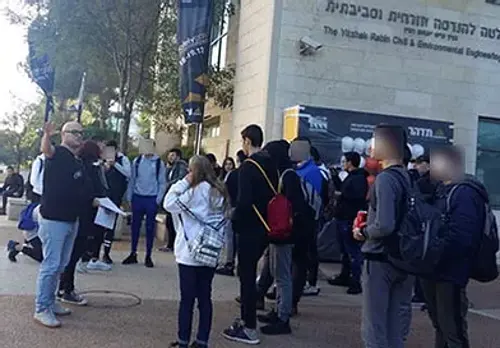


Naturally, people learn from a variety of experiences occurring in different situations, places, times, and contexts. In formal instruction as well, it is beneficial to encourage learning not only during classroom lessons but also across a variety of physical and online environments. Teachers can help students take advantage of unplanned learning opportunities, as well as create such opportunities, whether during a field trip, in a museum, or in different spaces within the school. In such cases, it is important to find ways to maintain continuity between these learning experiences.
Integrating different spaces, both physical and digital, can contribute to diversifying teaching approaches and fostering interest, motivation, and engagement among both students and teachers. Learning in environments outside the classroom, such as nature, museums, national parks, and other settings, is important not only for the cognitive aspects of learning but also for its social and emotional dimensions. For example, activities in nature can foster a sense of engagement and responsibility and promote action for the environment, while also supporting the physical and mental development of young people. Engaging with the local community can provide additional meaning to students’ activities, creating direct links to social, economic, and environmental issues within the community and offer opportunities to create change in students’immediate surroundings.
When learning takes place across different places and times, technology can help create connections and continuity between them. For example, students might take photographs in the field and later discuss them in the classroom, or prepare background materials that are used when visiting a museum. Digital environments extend across both time and space, and therefore offer advantages for creating such connections, especially given the widespread availability of technology today, when many students carry smartphones with them.
Scientific activity itself takes place across diverse environments, times, situations, and contexts. Therefore, exposure to different environments can make science learning more authentic and accessible. Collecting data about jellyfish, identifying animal tracks, or counting birds in home gardens are just a few examples of citizen science activities conducted in out-of-classroom environments. The digital environment is also a space in which scientific work takes place. One reason for the growth of the citizen science field is the widespread use of smartphones, which allow individuals to collect data through dedicated applications, the broad coverage of cellular networks, and the tools embedded in these devices (camera, light sensor, GPS, etc.).
Related Principles ▼
This principle is often implemented together with the principle of “Encourage civic engagement”.
The History of the Principle: This principle is a consolidation of three earlier principles: “Bridging learning in the classroom and beyond it”, “Bridging learning between school and the community”, and “Bridging the physical and digital environment”. The consolidation was based on the shared focus of these three principles on different learning spaces.
Citation:
Lavi-Alon, N., Tal, T., Kaplan-Mintz, K., Dolev-Shaham, R., Aridor, K., Velin, G., Kali, Y., Sagi, A., and members of the TCSS community (2021). Operational Principles, insights.edu.haifa.ac.il
Deepening and Expansion ▼
The pedagogy of outdoor learning. Tal and her colleagues have written extensively about the pedagogy of outdoor learning (2007, 2008, 2012, 2017b, 2017a, 2018). According to these researchers, it is important to create connections between classroom learning and learning “in the field,” forming a classroom–field–classroom sequence. This sequence should provide both conceptual and psychological preparation for outdoor learning. Such preparation should enable processing of the learning experience in terms of both content and social-emotional aspects, through the introduction of scientific concepts and the summarization of learning.
Because outdoor learning often involves interaction between teachers accompanying their classes and other educators representing the visited site, the authors suggest integrating the accompanying teachers and enable them a meaningful role in the outdoor activity. Their contribution may relate both to the content of learning and to their role as agents who know their students and their needs, which may include the need for student-centered pedagogy. The researchers’ studies were conducted primarily in museums, nature excursions, and ongoing projects in natural environments. However, their findings reflect principles that are also relevant to citizen science projects in which students collect data in the project’s research field as part of outdoor learning. In such contexts, questions also arise regarding the role of the teacher when scientists lead the activity, as well as the balance between cognitive and social-emotional dimensions of learning.
Citizen science as a bridge between science education, environmental education, and technology-based learning. In their article in the journal Science, Wals and colleagues (2014) present citizen science as a bridge connecting science education, environmental education, and technology-based learning. They point out that even people who do not typically spend time in nature may do so thanks to technology. According to the authors, participation in technology-supported citizen science strengthens learners’ connection to the physical environment in which they operate and improves their understanding of scientific work.
The effectiveness of using technology in science education
Zucker and colleagues (2008) describe an evaluation study of a project called TEEMSS II, which aimed to improve science education through the use of technological tools. In the project, students investigated scientific topics using sensors, computer models, and a virtual learning environment. The study examined the understanding of scientific concepts among 658 students who studied in the program and compared them with 523 students who had studied with the same teachers in previous years using standard instruction without technology. The findings indicate a positive effect of this type of technology use on student achievement in some domains, while also noting the need for additional research regarding the mechanisms that mediate this positive effect.
Additional Resources:
Lavi-Alon, N., & Tal, T. (2020). Principles for Outdoor Learning. Office of the Chief Scientist, Ministry of Education. Retrieved from https://meyda.education.gov.il/files/LishcatMadaan/Principlesforextracurricularlearning.pdf
“The Graduate Profile” (2021). National Pedagogical Policy of the Education System / 2021–2031. Retrieved from the Ministry of Education website: https://meyda.education.gov.il/files/Planning/dmuthabogermismach.pdf
References ▼
Alon, N. L., & Tal, T. (2017a). Teachers as secondary players: Involvement in field trips to natural environments. Research in Science Education, 47(4), 869-887.
Bamberger, Y., & Tal, T. (2008). Multiple outcomes of class visits to natural history museums: The students’ view. Journal of Science Education and Technology, 17(3), 274-284.
Kali, Y., (2006). Collaborative knowledge-building using the Design Principles Database. International Journal of Computer-Supported Collaborative Learning, 1(2), 187-201.
Kali, Y., Levy, K. S., Levin‐Peled, R., & Tal, T. (2018). Supporting outdoor inquiry learning (SOIL): Teachers as designers of mobile‐assisted seamless learning. British journal of educational technology, 49(6), 1145-1161.
Lavie Alon, N., & Tal, T. (2017b). Field trips to natural environments: how outdoor educators use the physical environment. International Journal of Science Education, Part B, 7(3), 237-252.
Morag, O., & Tal, T. (2012). Assessing learning in the outdoors with the field trip in natural environments (FiNE) framework. International Journal of Science Education, 34(5), 745-777.
Tal, T., & Morag, O. (2007). School visits to natural history museums: Teaching or enriching?. Journal of Research in Science Teaching: The Official Journal of the National Association for Research in Science Teaching, 44(5), 747-769.
Wals, A. E. J., Brody, M., Dillon, J., & Stevenson, R. B. (2014). Convergence between science and environmental education. Science, 344, 583–584.
Zucker, A. A., Tinker, R., Staudt, C., Mansfield, A., & Metcalf, S. (2008). Learning science in grades 3–8 using probeware and computers: findings from the TEEMSS II project. Journal of Science Education and Technology, 17(1), 42-48.